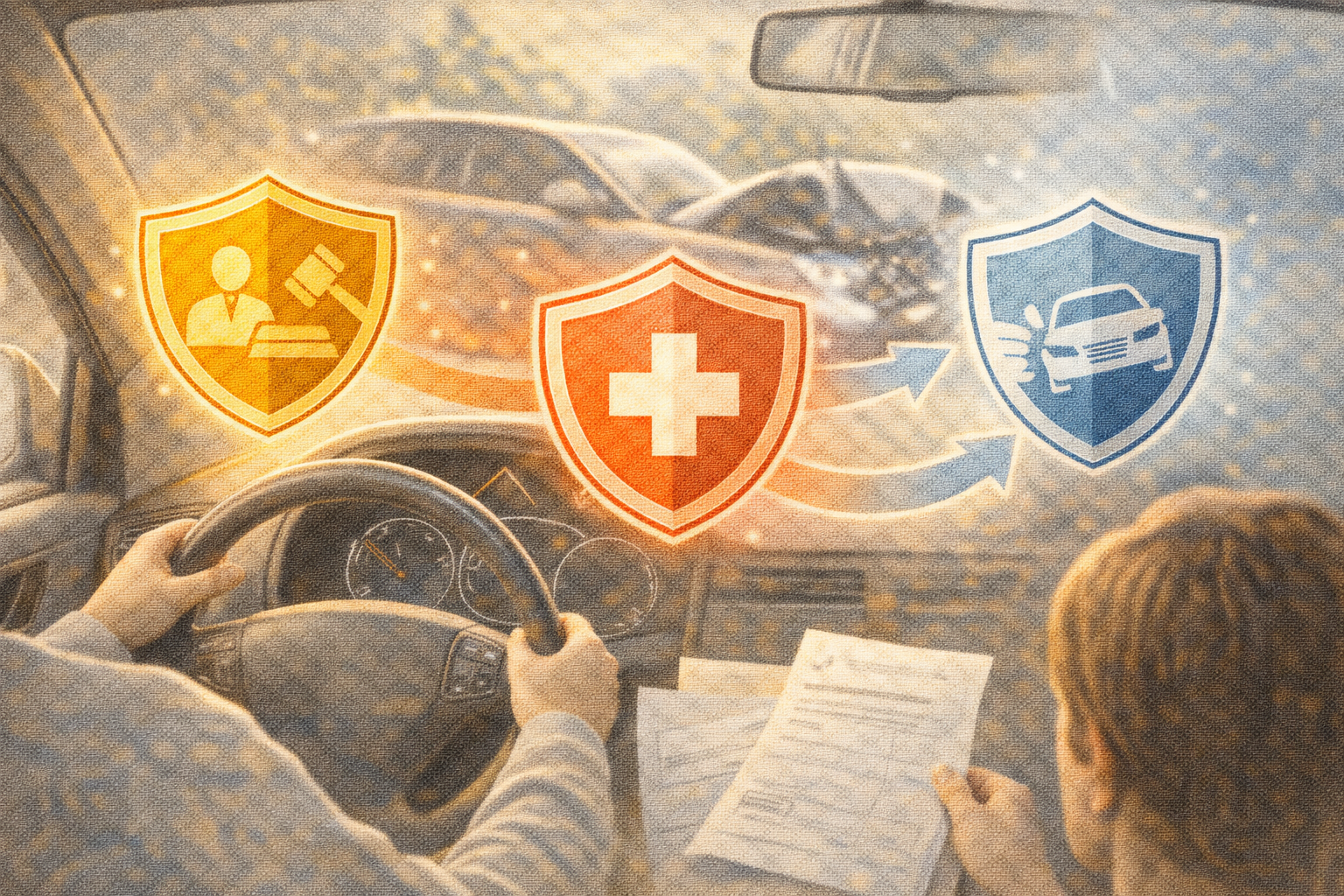
You borrowed a friend’s car, ran a light, and hit someone. Now three parties — you, your friend, and both insurers — are staring at the same question: whose policy pays? The answer follows a strict sequence in most states, but the sequence has known failure points. This guide walks through who pays in the normal case, the five situations that break the normal case, and exactly how a non-owner claim proceeds from the scene to settlement.
The default sequence: owner first, driver second
In nearly every state, insurance follows the car before it follows the driver. The owner’s policy is primary: its liability limits respond first to injuries and property damage you cause while driving with permission.
Your non-owner policy is excess. It activates for the amount above the owner’s limits, up to your own limits, and it also defends you if a lawsuit names you personally. That defense function matters — an attorney at $350 an hour is often the most valuable part of the policy.
Permission is the hinge. Permissive use is what makes the owner’s policy respond at all, and the definition is narrower than most people assume.
Break point one: you did not have permission
Take the car without explicit consent — even a household member’s car — and the owner’s insurer can deny the claim outright. Some policies extend an inference of permission for family members; virtually none extend it to friends who “would have said yes.”
In these cases your non-owner policy becomes primary rather than excess, which sounds better until you realize state-minimum non-owner limits are all that stands between you and personal liability for everything above them.
Break point two: the owner’s policy excludes you
Many personal policies contain named-driver exclusions or exclude drivers living in the household who are not listed. If the owner’s policy excludes you as a driver, it will not defend you or pay a dollar, and your non-owner policy responds from the first dollar as primary.
Livery and business use exclusions also appear here. Borrow a car to deliver food for pay, and the owner’s personal policy may void itself for that trip; your non-owner policy also excludes commercial use, which is why delivery work without a commercial policy is uncovered on both sides.
| Situation | Owner’s policy | Your non-owner policy |
|---|---|---|
| Permissive use, adequate limits | Primary, pays to limits | Excess, rarely triggered |
| Permissive use, state minimums | Primary to low limits | Pays excess to your limits |
| No permission given | Usually denies | Responds as primary |
| Driver excluded on owner’s policy | Denies entirely | Responds as primary |
| Owner uninsured | N/A | Responds as primary for liability |
| Damage to the borrowed car | Collision (their own) | Never covers it directly |
Break point three: the owner carries state minimums
This is the most common real-world gap. The owner’s 25/50/25 policy pays its $50,000 toward injuries, and the injured party’s medical lien alone can exceed that. Your non-owner policy then pays excess — but only up to your limits.
If you carry state-minimum non-owner limits, the sequence produces the same underinsurance problem it was meant to solve. If you carry 100/300, the layering works as designed and the injured parties are made whole up to those numbers.
Break point four and five: uninsured owners and vehicle damage
Some owners let coverage lapse entirely. In that scenario your non-owner policy pays as primary for liability, but there is no collision coverage anywhere for the friend’s own car, and you may face the friend’s out-of-pocket claim directly.
And the standing rule surprises everyone: damage to the borrowed car itself is never your non-owner policy’s job. If the friend carries collision, their insurer pays for their own car and may pursue subrogation against you — meaning your non-owner liability insurer can be asked to reimburse them for the damage you caused to their vehicle.
The claim, step by step
At the scene: exchange information including the owner’s insurance details, photograph positions and damage, and get the police report number. Do not speculate about fault at the scene, and do not apologize in ways that read as an admission.
Within 24 hours: notify both insurers — the owner’s carrier because their policy is primary, and yours because excess claims develop legal costs early. Give a factual recorded statement only after you know what the owner’s policy will accept.
Weeks one through six: the owner’s carrier adjusts the claim, assigns fault percentage, and either tenders limits or closes within them. Your carrier monitors, contributes excess when triggered, and coordinates defense if a suit is filed.
If injured parties hire attorneys, expect the process to move to demand-and-negotiation. This is where your excess limits earn their price: counsel for the plaintiff reviews both policies, and a well-layered file settles rather than litigates.
Documentation checklist for the borrower
Police report number and responding officer name; photographs of all vehicles, positions, and the intersection; the owner’s insurance card front and back; your own non-owner declarations page; names and numbers of witnesses; the repair estimate or total-loss valuation on the borrowed car; and every letter both insurers send you, in order.
One more item borrowers forget: write down what you were doing in the car — commute, errand, helping move — because use-type questions arrive within days and inconsistencies between your statement and the owner’s statement are the most common reason excess claims stall.
- Insurance follows the car: the owner’s policy is always the first layer.
- Non-owner coverage is excess — until permission, exclusions, or lapses break the chain.
- The borrowed car itself is repaired through the owner’s collision coverage, not yours.
- Notify both insurers within 24 hours; late notice is a top reason excess claims stall.
- Keep a written account of the trip’s purpose before giving any recorded statement.
The layering system works only if your excess layer is actually thick. The difference between 25/50 and 100/300 non-owner limits is usually under $20 a month — and in a serious borrowed-car accident it is the line between a settled claim and a personal lawsuit.
Key takeaways
- Owner’s policy primary, non-owner policy excess — memorize the sequence.
- Permission, named exclusions, and lapses are the three claims that get denied.
- Vehicle damage to the borrowed car runs through the owner’s collision coverage.
- Both insurers should hear from you within 24 hours of any borrowed-car accident.
- Higher non-owner limits are what convert the sequence from theory into protection.
Frequently asked questions
If I crash my friend’s car, does my insurance pay for their car?
Not directly. Their collision coverage repairs their car. Your non-owner liability insurer may later reimburse their insurer through subrogation if you were at fault.
Does the car owner’s insurance cover me automatically?
If you had permission to drive and are not excluded, yes — their liability coverage is primary for accidents you cause while driving.
What if my friend’s insurance denies the claim?
Your non-owner policy steps up from excess to primary, paying from the first dollar up to your limits. This is the scenario where non-owner coverage justifies itself completely.
Should I report a borrowed-car accident to my insurer if it seems minor?
Yes. Late notice is one of the most common grounds for excess-claim disputes, and “minor” injuries often develop into claims months later.
Does a non-owner policy cover rental cars after an accident?
It covers liability you cause in a rental as excess over the rental company’s fleet liability, but never the damage to the rental vehicle itself.