

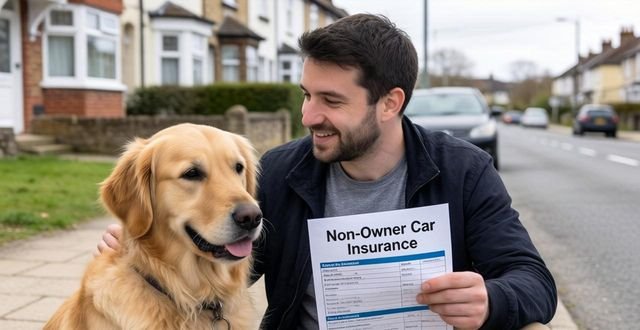
You’re sitting in a coffee shop on 147th Street, scrolling through listings for a new apartment closer to the city. The train from Midlothian into the Loop is reliable, but you’ve been thinking about those weekend trips to the Orland Square Mall or that new restaurant in Homewood. You don’t own a car, but you use a car-sharing service a few times a month. Or maybe you’re planning a longer visit to see family out of state and will need to rent a vehicle. The thought crosses your mind: “What happens if I get into an accident?” Then, a quieter, more persistent worry follows—the one about an unexpected bill wiping out your savings, about a liability claim that threatens your future earnings. This is where the conversation about non-owner car insurance begins. Not with a dry definition, but with the very real need for financial security in a world where your access to a vehicle is occasional, but the risks are not.
Let’s dismantle the concept, piece by piece. A non-owner auto policy is not for a specific vehicle; it’s for a specific driver. It provides liability coverage that follows you when you operate a vehicle you do not own. Think of it as a portable shield. The moment you slide behind the wheel of a borrowed car from a friend, a rented sedan from an agency at Midway Airport, or a vehicle from Turo or Zipcar, this policy is activated. It becomes your primary layer of liability coverage. Here is where things get tricky, and most standard explanations fail. They don’t tell you about the consequences of not having it. If you cause an accident while driving a friend’s car, their insurance responds first. But what if the damages exceed their policy limits? The claim can come directly for your personal assets. Your savings, your future wages—they can be garnished to satisfy a judgment. A non-owner policy is your financial backstop. It is an explicit acknowledgment that your driving risk is independent of car ownership.
Now, let’s talk about the carriers and the details that matter. In Illinois, the minimum liability requirements are 25/50/20. Many non-owner policies from major national carriers will offer you limits starting at state minimums and going up to 500/500 or even 1 million in combined single limits. The premium difference between a 100/300 policy and a 250/500 policy is often surprisingly small, but the protection gap is massive. But there is a catch. Not all non-owner policies are created equal. Some, often from the more budget-conscious carriers, may have exclusions for vehicles rented for business purposes or for ridesharing activities. Others might offer broader coverage, including, for an additional premium, a degree of physical damage coverage for rental vehicles—though this is frequently secondary to any coverage offered by the rental company’s collision damage waiver.
We must also address the tax implications, a point often glossed over. Payments you receive from a standard personal auto insurance policy for a covered loss are generally not considered taxable income by the IRS. This principle holds true for liability payouts from a non-owner policy as well. You are being indemnified for a loss, not receiving a windfall. However, contrast this with a potential alternative: relying on a credit card’s rental car coverage or a employer’s business travel insurance. Reimbursements from those sources can sometimes have different tax treatments, and they are rarely as comprehensive or driver-focused as a dedicated non-owner policy. The certainty of a clean, non-taxable indemnity payment is a hidden value of this product.
Where do people in Midlothian, Oak Forest, or Crestwood typically go wrong?

“My friend’s insurance will cover me.” It will, initially. But it is their policy, with their limits, protecting their insurable interest first. If you are a frequent driver of that vehicle, the carrier could even deny the claim altogether, arguing you should have been listed on the policy. You are a guest in their insurance world, not a resident.
“The rental company’s insurance is enough.” The liability coverage offered at the rental counter is usually secondary and can be frightfully expensive on a per-day basis. That $25-a-day fee adds up fast for a two-week trip. A non-owner policy provides primary liability coverage,often making the rental company’s expensive liability product unnecessary. You might still need their collision damage waiver for the vehicle itself, but your liability shield is already in place.
“I’ll just risk it for a short drive.” This is the most dangerous assumption. A severe accident is not a function of distance; it is a function of moment. The five-minute drive to the Jewel-Osco on Pulaski Road carries the same catastrophic liability risk as an hour on I-57.
So, what is the actionable path forward? Do not treat this as a theoretical exercise. If you are a city resident who occasionally drives in the south suburbs, a frequent business traveler flying out of Chicago, or someone in a multi-car household who is the designated “occasional driver” but not a titled owner on any vehicle, you need to have this conversation. Contact an independent agent—someone who can quote you with multiple carriers, like Progressive, National General, or Dairyland, to find the right fit. Be prepared to discuss your driver’s license history, your estimated annual mileage in non-owned vehicles, and your specific use cases. Ask pointed questions: “Are there exclusions for ride-sharing apps?” “How does this policy interact with a rental company’s CDW?” “What is the cost difference to increase my liability limits from 100/300 to 250/500?”
The goal is not to sell you a policy. The goal is to close a gap in your financial defenses that you may not have even known was there. In a time of economic uncertainty, where a single lawsuit can dictate your financial trajectory for years, the modest premium for a non-owner policy is not an expense. It is a direct investment in preserving your future income and your peace of mind. The security it buys is quiet, unassuming—right up until the moment you desperately need it to speak for you.